Introduction
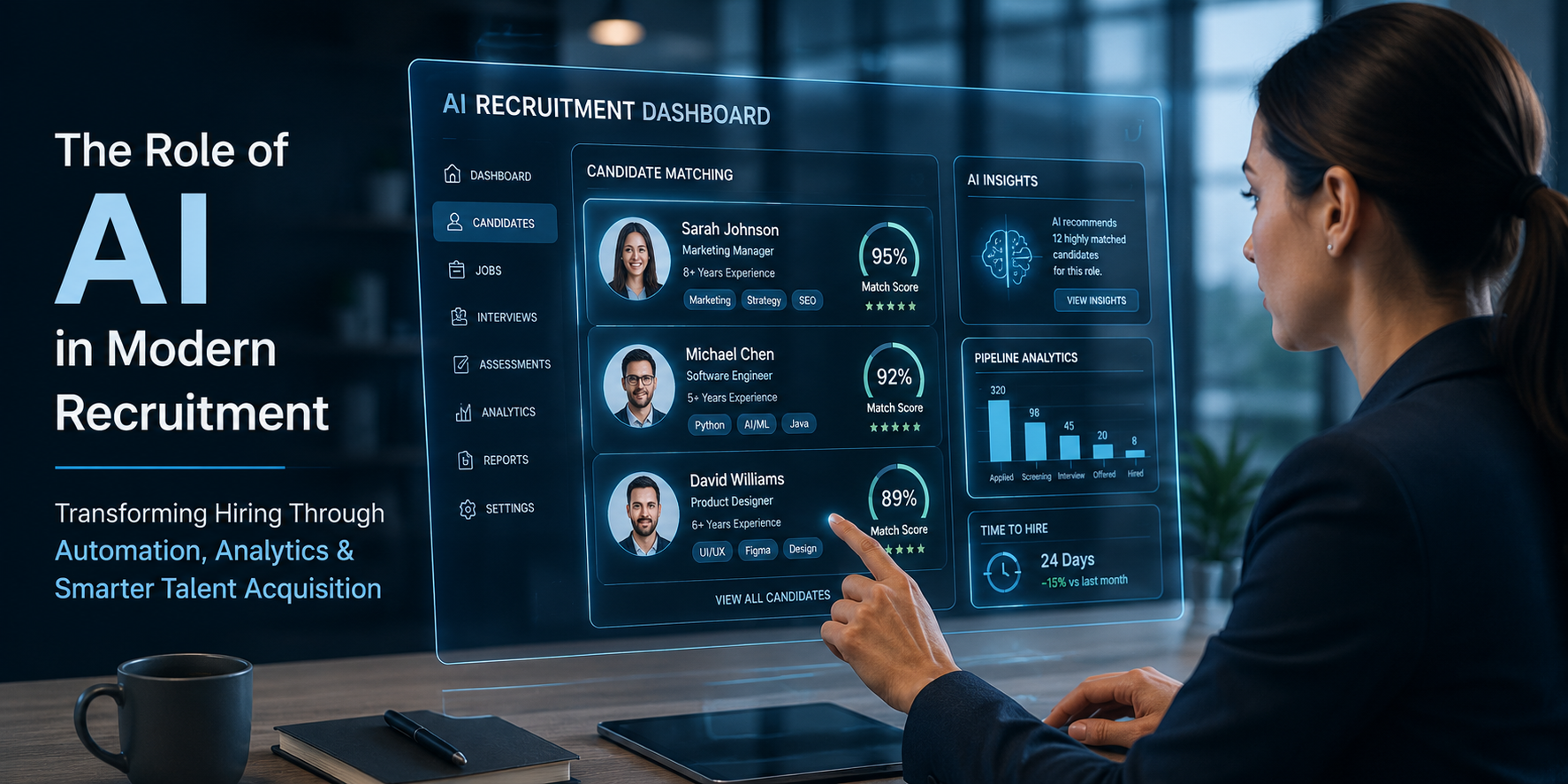
The recruitment industry has undergone a significant transformation over the past decade. With increasing competition for talent, evolving candidate expectations, and the growing demand for faster hiring processes, organizations are continuously seeking innovative ways to improve recruitment efficiency. One of the most impactful developments in recent years has been the adoption of Artificial Intelligence (AI) in recruitment.
AI is revolutionizing how businesses attract, assess, and hire talent. From automating repetitive tasks to providing data-driven insights, AI enables recruiters to make better hiring decisions while saving time and reducing costs. As organizations strive to build stronger workforces, AI has become an essential tool in modern recruitment strategies.
This article explores the role of AI in recruitment, its benefits, challenges, and how it is shaping the future of hiring.
What is AI in Recruitment?
Artificial Intelligence in recruitment refers to the use of machine learning, natural language processing, predictive analytics, and automation technologies to streamline hiring processes.
AI-powered recruitment tools can assist with:
- Candidate sourcing
- Resume screening
- Job matching
- Candidate engagement
- Interview scheduling
- Skills assessments
- Recruitment analytics
- Employee onboarding
These technologies help recruiters focus on strategic hiring decisions rather than administrative tasks.
Why AI is Becoming Essential in Recruitment
The modern recruitment landscape is more competitive than ever. Organizations often receive hundreds or even thousands of applications for a single position.
Recruiters face challenges such as:
- High application volumes
- Time-consuming screening processes
- Talent shortages
- Pressure to reduce hiring timelines
- Increasing recruitment costs
AI helps address these challenges by automating repetitive processes and improving hiring efficiency.
As a result, companies can identify qualified candidates faster and deliver a better recruitment experience.
Faster Resume Screening
One of the most time-consuming aspects of recruitment is reviewing resumes.
A recruiter may spend several hours evaluating applications for a single role. When multiple vacancies exist, this process becomes overwhelming.
AI-powered screening tools can:
- Analyze resumes within seconds
- Identify relevant skills
- Match qualifications with job requirements
- Rank candidates based on suitability
- Filter out unqualified applications
This significantly reduces the time required for candidate screening and helps recruiters focus on top talent.
Improved Candidate Sourcing
Finding qualified candidates can be challenging, particularly for specialized positions.
AI-powered sourcing tools search multiple platforms, including:
- Job portals
- Professional networks
- Internal databases
- Social media channels
These systems identify potential candidates based on experience, skills, education, and industry expertise.
By expanding the talent pool and improving search accuracy, AI helps recruiters connect with high-quality candidates who may otherwise be overlooked.
Better Candidate Matching
Traditional recruitment often relies heavily on manual judgment.
AI improves hiring decisions by analyzing large volumes of data to determine candidate suitability.
Modern AI systems evaluate factors such as:
- Skills and certifications
- Work experience
- Educational background
- Career progression
- Industry expertise
Some advanced platforms can even assess candidate-job compatibility based on historical hiring data.
This leads to better matches between employers and candidates, improving retention and job satisfaction.
Enhancing Candidate Experience
Candidate experience has become a critical factor in employer branding.
Slow responses and poor communication can cause organizations to lose top talent.
AI-powered chatbots help improve candidate engagement by providing:
- Instant responses
- Application updates
- Interview scheduling assistance
- Frequently asked question support
- Job recommendations
These tools operate 24/7, ensuring candidates receive timely information throughout the recruitment journey.
A positive candidate experience increases the likelihood of attracting and retaining top talent.
Reducing Time-to-Hire
Speed is essential in today’s job market.
Highly qualified candidates often receive multiple offers and may accept opportunities before lengthy recruitment processes are completed.
AI helps reduce time-to-hire by automating several stages of recruitment, including:
- Resume screening
- Candidate shortlisting
- Communication workflows
- Interview scheduling
Faster hiring processes enable organizations to secure top candidates before competitors do.
Data-Driven Hiring Decisions
Recruitment decisions should be based on evidence rather than assumptions.
AI provides valuable insights through recruitment analytics.
Organizations can track metrics such as:
- Source effectiveness
- Candidate conversion rates
- Interview success rates
- Hiring timelines
- Recruitment costs
These insights help HR teams optimize hiring strategies and improve overall recruitment performance.
Data-driven recruitment leads to better workforce planning and stronger hiring outcomes.
Reducing Recruitment Costs
Recruitment can be expensive when businesses rely solely on manual processes.
Costs may include:
- Advertising expenses
- Recruiter time
- Administrative resources
- Interview coordination
- Candidate sourcing efforts
AI reduces these expenses by automating repetitive tasks and improving efficiency.
By shortening hiring cycles and increasing recruiter productivity, organizations can significantly reduce recruitment costs.
Supporting Diversity and Inclusion
Diversity and inclusion have become important priorities for many organizations.
AI can help reduce unconscious bias by focusing on objective candidate qualifications rather than subjective factors.
Some AI systems evaluate:
- Skills
- Experience
- Competencies
- Performance indicators
This helps create a more consistent and fair evaluation process.
However, organizations must carefully monitor AI systems to ensure algorithms themselves do not introduce bias.
Predictive Analytics in Recruitment
One of AI’s most powerful capabilities is predictive analytics.
By analyzing historical hiring and employee performance data, AI can forecast:
- Candidate success rates
- Employee retention likelihood
- Future hiring needs
- Workforce trends
These insights help organizations make proactive hiring decisions and improve workforce planning.
Predictive analytics allows businesses to build stronger teams while minimizing recruitment risks.
AI-Powered Video Interviews
Many companies now use AI-enhanced video interviewing platforms.
These systems can assist with:
- Automated interview scheduling
- Candidate assessments
- Structured evaluation processes
- Interview analytics
AI helps standardize interviews and improve consistency across hiring decisions.
This is particularly valuable for organizations conducting large-scale recruitment campaigns.
The Benefits of AI in Recruitment
Organizations implementing AI recruitment solutions often experience:
Faster Hiring
Automation reduces time spent on administrative tasks.
Higher Productivity
Recruiters can focus on strategic hiring activities.
Better Candidate Quality
AI improves matching accuracy.
Reduced Recruitment Costs
Automation lowers operational expenses.
Improved Candidate Experience
Faster communication enhances engagement.
Data-Driven Insights
Analytics support informed decision-making.
Scalability
AI can manage large recruitment volumes efficiently.
These benefits contribute to stronger recruitment outcomes and business growth.
Challenges of AI in Recruitment
While AI offers numerous advantages, it is not without challenges.
Algorithm Bias
AI systems learn from historical data. If the data contains bias, hiring recommendations may also become biased.
Data Privacy Concerns
Recruitment involves sensitive personal information.
Organizations must ensure compliance with data protection regulations and maintain candidate confidentiality.
Lack of Human Judgment
AI cannot fully evaluate qualities such as:
- Emotional intelligence
- Cultural fit
- Leadership potential
- Interpersonal skills
Human recruiters remain essential for making final hiring decisions.
Technology Costs
Implementing advanced AI recruitment tools may require significant investment, particularly for smaller organizations.
Despite these challenges, the benefits of AI often outweigh the limitations when implemented responsibly.
The Future of AI in Recruitment
AI adoption in recruitment continues to grow rapidly.
Future developments may include:
- Advanced predictive hiring models
- Personalized candidate experiences
- Improved skills assessments
- Real-time workforce analytics
- AI-driven career path recommendations
- Enhanced recruitment automation
Rather than replacing recruiters, AI will continue to support HR professionals by handling repetitive tasks and providing valuable insights.
Human expertise combined with AI technology will create more effective recruitment processes.
Conclusion
Artificial Intelligence is transforming modern recruitment by making hiring faster, smarter, and more efficient. From resume screening and candidate sourcing to predictive analytics and automated communication, AI helps organizations overcome recruitment challenges while improving hiring outcomes.
Businesses that embrace AI recruitment technologies can reduce hiring costs, improve candidate experiences, access better talent, and make more informed decisions. However, successful implementation requires balancing automation with human judgment to ensure fair and effective hiring practices.
As the recruitment landscape continues to evolve, AI will play an increasingly important role in helping organizations attract, engage, and retain top talent. Companies that leverage AI strategically will be better positioned to compete in the modern workforce and achieve long-term business success.